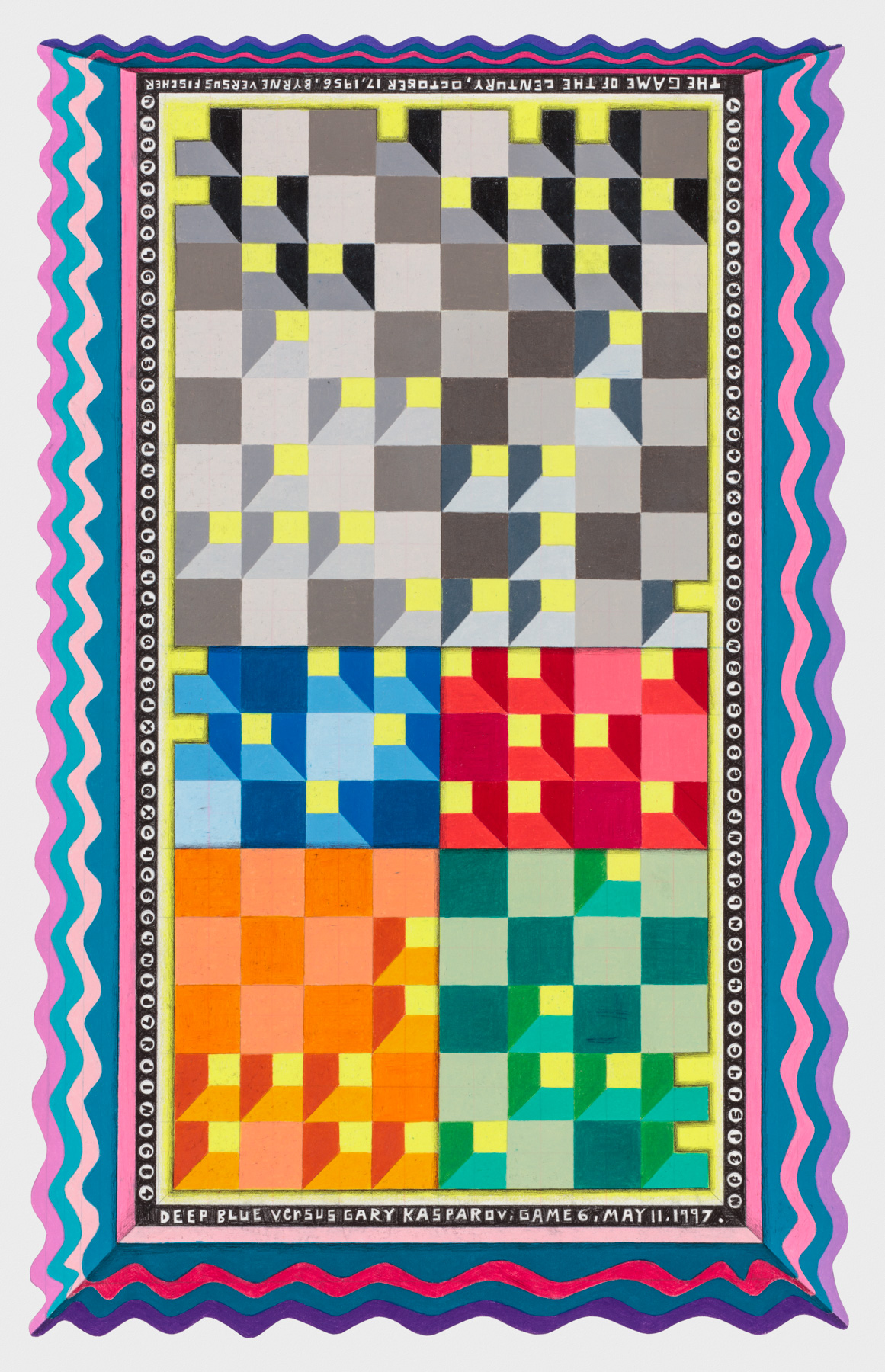
The Games of the Century
30 × 18.5 inches, graphite and Colored Pencil on shaped paper
In this drawing, I plotted the pattern of chess pieces at the turning points of two historic matches: 13-year-old Bobby Fischer’s 1956 "Game of the Century" against Donald Byrne, and Garry Kasparov’s 1997 defeat by the Deep Blue supercomputer. By mapping the board at these critical moments, I explored the transformative intersections where one intellect surpasses another before the original power understands what has even happened, when the future is already preordained. The top half of the drawing translates the pattern of pieces at the exact moment Fischer mathematically sealed Byrne's fate, while the bottom half maps the specific board status where Kasparov's human intellect was officially surpassed by computational power.
I was interested in how the concept of the "machine" drove both of these power shifts, yet in inverted ways. In 1956, the human acted as the machine: a child prodigy executing forced moves with algorithmic precision to overthrow an established master. In 1997, the machine became almost human: a supercomputer making subtle, seemingly intuitive choices that psychologically broke the apex human player.
To visualize this unseen shift, I mapped the piece placements via isometric 3D extrusions and data points. The patterns of the two boards are positioned as mirror images of one another, like a conceptual inversion of the "machine" across the two eras. By mapping the exact moment the game’s complexity mutated beyond the established power's perception, the drawing diagrams a systemic phase change. I saw it as a visual "Thucydides Trap," capturing the gap between the structural inevitability of defeat and the human realization of it.